Who this is for
This is written for dental practices, DSOs, labs, and partners who are seeing the same pattern: patients want clarity early, but clinicians do not want to become full-time explainers, persuaders or reluctant salespeople.
Why this matters now
The patient journey starts long before the first appointment. By the time someone sits in a chair, the person has usually scrolled through photos, compared clinics and formed opinions, but is still uncertain.
That tension shows up in consultations. The clinical side may be clear, but the patient is still trying to answer a simpler question:
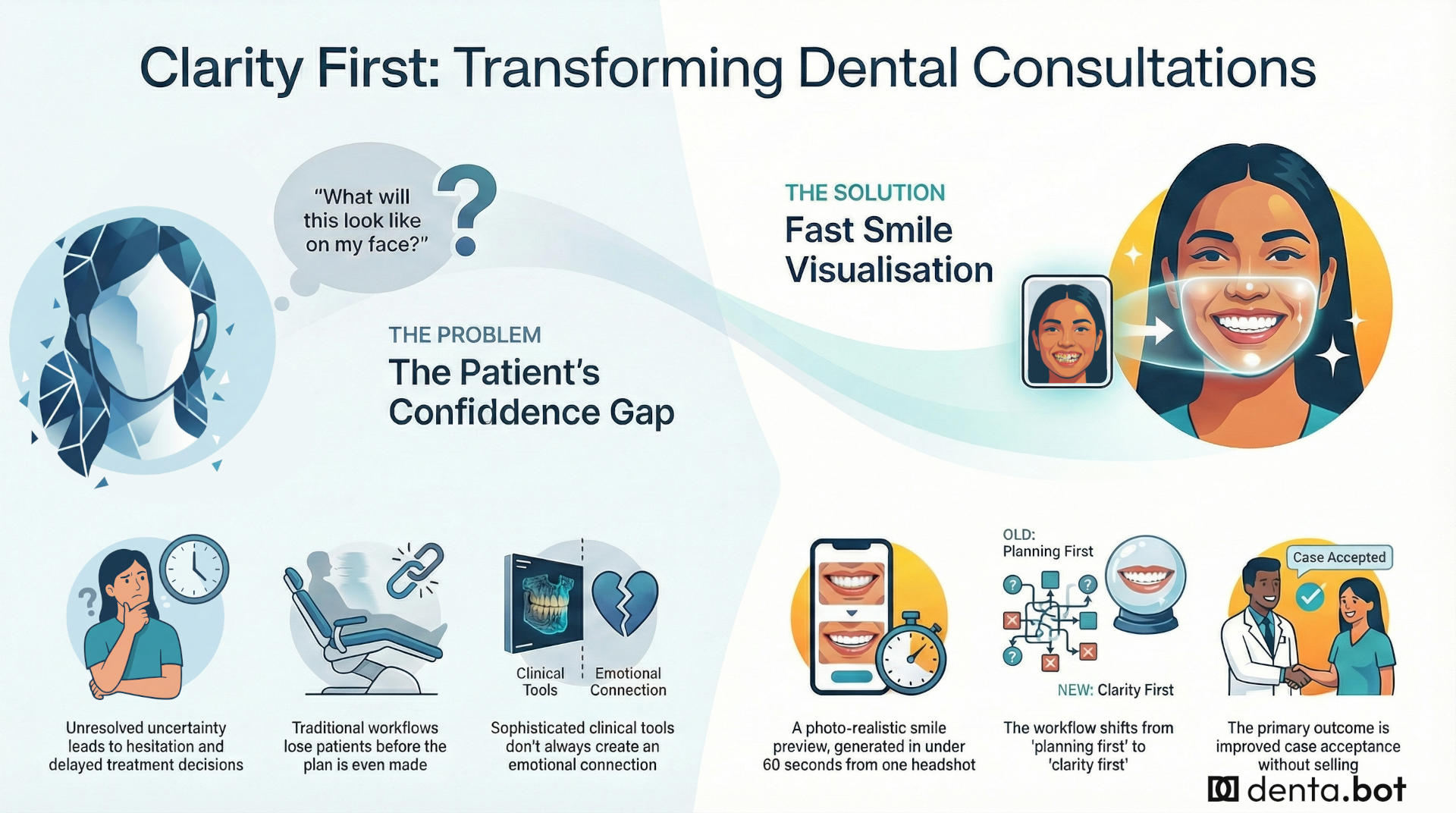
What will this look like on my face?
When that question stays unresolved, the appointment tends to stretch. There is more explaining, more “options,” more follow-up chasing, and more cases that fade into “let me think about it.”
Fast Smile Visualisation is appearing in more clinics because it tackles that early uncertainty. By helping patients imagine their future smile, it builds confidence early and makes the time invested in treatment planning more justified.
A clearer definition of “Fast Smile Visualisation”
Fast Smile Visualisation means something specific in this context.
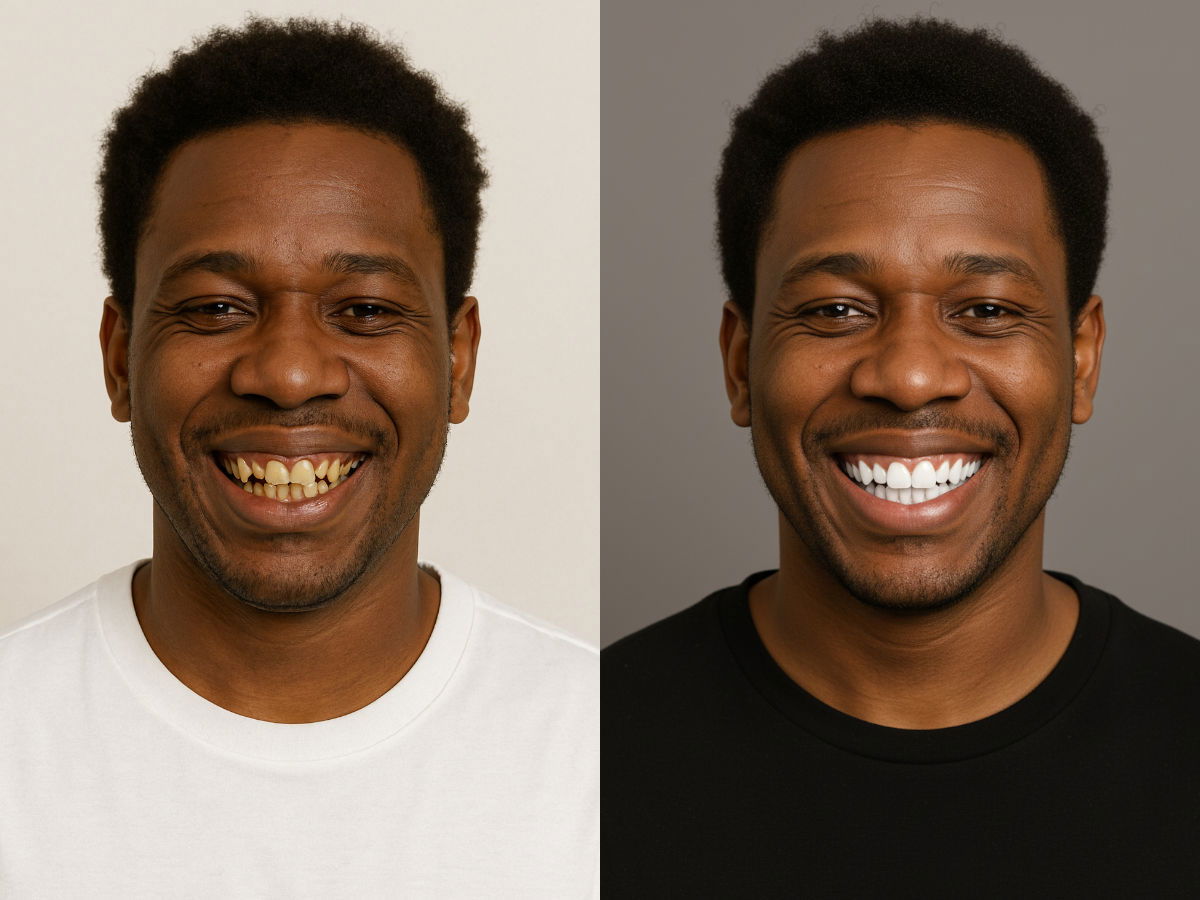
It is the ability to take a single headshot photo of a patient smiling (with the upper and lower arches visible) and convert it into a photo-realistic smile preview in under 60 seconds.
Two requirements matter most:
- Face-accurate resemblance: the generated image unquestionably looks like the same person. Same face, same overall expression, same identity.
- Improved, appealing dentition: the teeth are updated in a way that suits the patient’s face. It should look plausible and believable, not like a Photoshopped image with a few in-fills and the exposure turned up.
This is the core of face-realistic smile visualisation: the preview must feel personal, not templated or "cousin-like"
In practice, Fast Smile Visualisation functions as a cosmetic dentistry visualisation tool that helps establish direction before committing time to full records and planning.
If the preview takes ten minutes, the moment is often gone. If it takes two days, the patient is already price-shopping other dentists. Allowing the patient to see their new smile in their face in under a minute is compelling. It's the practical threshold where realistic visualisation can comfortably live inside the dental clinic workflow.
The category shift: from “planning first” to “clarity first”
For years, many workflows implicitly assumed a straight line:
- enquiry
- consultation
- records
- plan
- acceptance
In reality, many elective cases are not lost because the plan is weak. They are lost because the patient never becomes certain enough to begin the journey required to reach the plan.
Fast Smile Visualisation changes what happens first. It introduces clarity before complexity.
Clarity first. Complexity and millimeter precision second.
- First: a believable direction the patient can recognise on the patient’s own face.
- Then: records, planning, sequencing, consent, and delivery.
At first glance, this can seem unnecessary because modern clinics already have sophisticated tools. Intraoral scanning is routine. Planning software can show tooth movement beautifully in 3D. Some systems even offer face mock-ups.
The issue is that these tools do not always solve the early confidence gap:
- The 3D view is often “teeth in space”. Clinically useful, but not always something a patient can emotionally connect with.
- Face mock-ups that look genuinely realistic can take too long to generate to be helpful in the moment.
- Same-visit face mock-ups do exist, but if the image does not strongly resemble the patient or the dentition looks unconvincing, many clinicians hesitate to show the generated images. That hesitation is sensible. It protects trust.
This is the gap Fast Smile Visualisation fills. It gives a fast, face-realistic preview early enough to matter. Then the clinical workflow follows, with more justification for time spent on records and planning.
It is a small shift, but it matches how people make decisions. Early decisions are emotional and identity-based. Later decisions become practical and clinical.
When the order is reversed, clinics often do a lot of planning for patients who were never psychologically ready to proceed. That is wasted time for the team, and it quietly drains capacity.
What it is (and what it is not)
What it is
Fast Smile Visualisation is a front-end conversation tool. It is designed to quickly establish:
- what the patient means by “I want a better smile”
- whether the patient likes a given direction
- whether the patient is motivated enough to move to records and proper planning
In other words, it creates a shared reference point early.
What it is not
Fast Smile Visualisation is not:
- diagnosis
- traditional digital smile design
- orthodontic planning software
- a substitute for intraoral scanning, photographs and records
- a vendor funnel that quietly pushes one product line
This distinction is not just semantic. It protects trust.
Clinicians do not need another system that competes with planning. Practices do not need another tool that forces a sales tone. The best role for Fast Smile Visualisation is upstream and lightweight.
The real bottleneck: patients struggle to imagine outcomes
Most patients are not struggling with information. Many are overwhelmed by it.
They can understand “straight teeth” or “whiter teeth” as concepts. They often cannot translate those concepts into a confident picture of themselves.
So the first appointment becomes an exercise in bridging imagination:
- example cases are shown
- options are explained
- timelines are discussed
- reassurance is offered
It is helpful, but it does not always resolve the key uncertainty. The patient is still trying to picture a different version of the same face.
A face-accurate preview reduces that uncertainty. It gives the patient a personal anchor. Not perfect. Not final. But personal and immediate.
That changes the tone of the consultation. Instead of persuasion, it becomes preference and expectation-setting.
Why speed matters more than tooth-movement accuracy at this stage
In treatment planning, accuracy is everything. In early-stage visualisation, accuracy is not the limiting factor.
The limiting factor is attention and readiness.
If providing a preview to the patient requires a complex process, adoption drops. If it requires ideal conditions, it becomes “that thing that gets used occasionally.” If it requires multiple handoffs, it becomes another operational thread to manage.
The value comes from being quick enough to sit naturally inside a conversation. The patient is engaged. The clinician is present. The team is moving.
That is why speed is not a “nice to have.” It is a condition for real-world use.
Why facial realism beats “perfect dentistry visuals” early on
Early decision-making is rarely about millimetres. It is about identity.
The first internal question is often:
- “Will this still look like me?”
If the preview does not resemble the patient strongly enough, trust weakens. If the teeth look too artificial, the preview becomes a distraction rather than a confidence builder.
Facial realism matters because it keeps the preview grounded. It signals that the outcome is being considered in context, not as a generic before-and-after fantasy.
This is also why Fast Smile Visualisation appears across different treatment categories. The patient is choosing a direction first. The route to get there can be discussed afterwards.
Where it fits in workflow without disrupting clinical process
Fast Smile Visualisation works best when treated as an early-stage layer, not as part of planning.
A practical flow looks like this:
- Capture a suitable photo (or use one the patient has already shared).
- Generate a preview quickly to establish direction.
- Confirm motivation and preferences.
- Only then move to records, planning and formal options.
This reduces the number of cases where significant clinical time is invested before the patient is ready.
It also changes what “consultation” means. Instead of starting with technical detail, the conversation starts with clarity. That earns attention and makes later explanations easier to land.
Two clinic-led use cases that keep showing up in practices
Chair-side: “Help me see what that means”
Chair-side previews are useful when the patient is uncertain and needs a clear visual reference.
This is common in:
- adult ortho cases where motivation is mixed
- cosmetic cases where the patient cannot articulate preferences
- “I hate my smile, but I’m not sure what I want” situations
In straightforward terms, this is chair-side smile simulation. It creates a shared reference without turning the consultation into a long explanation of concepts that sound perfectly clear to dentists and slightly abstract to everyone else.
Even with a clear explanation, words take time. A face-accurate preview gets everyone aligned in seconds.
Clinic-mediated follow-up: “Send me your headshot and I’ll send you options”
Sometimes the best moment to use a preview is between visits — after an enquiry or first conversation, or as follow-up when the patient is still uncertain.
In this flow, the patient shares a suitable smiling headshot with the practice (for example via email, WhatsApp, or SMS). The dentist or team generates a small set of previews and shares them back, so the next appointment starts from a shared visual reference rather than imagination.
Why this works operationally:
- Control: the practice stays in the driver’s seat — no new public tool for patients to navigate.
- Privacy by default: the practice handles consent and data minimisation within its existing workflow.
- Readiness: patients arrive clearer on direction and preferences, making the consult calmer and more efficient.
This is still the same product category: Fast Smile Visualisation. The only difference is timing. It supports chair-side discussion and clinic-mediated follow-up without becoming a patient self-serve portal.
Why practices adopt it, even when “marketing tools” are unwelcome
Many clinicians dislike tools that feel like marketing. Not because marketing is inherently bad, but because it can start to feel like selling rather than clinical communication.
Fast Smile Visualisation tends to be adopted when it produces practical outcomes:
- less explaining
- fewer awkward selling moments
- better questions earlier
- cleaner handoffs between clinicians and team members
- more efficient consults
The phrase that comes up repeatedly, sometimes said explicitly and sometimes implied, is this: improve case acceptance without selling.
When the picture does the heavy lifting, the conversation stays clinical.
The best version of this is quiet. The preview does not “close.” It simply reduces uncertainty and lets the clinical conversation start from a calmer place.
Manufacturer independence protects clinical freedom
One concern that comes up repeatedly in dental technology is subtle lock-in. A tool appears helpful, then nudges workflow toward one system, one supplier, or one narrative.
Fast Smile Visualisation works best when it stays neutral.
Neutrality keeps it in its rightful place:
- upstream of planning
- compatible with Invisalign and alternatives
- supportive of multiple treatments, not one branded pathway
This is where a manufacturer-independent smile simulator earns its keep. The tool supports confidence and conversation, while clinical choice remains fully intact.
That matters for individual practices. It matters even more for groups, labs, and partners who cannot afford to reorganise operations around a single vendor’s priorities.
The “don’t oversell it” rule that protects trust
Fast smile previews can backfire if presented as a guarantee.
Trust is protected by simple framing:
- “This is a quick preview to show the general direction.”
- “It’s not the final plan, but it helps clarify preferences.”
- “If this direction feels right, records and proper planning come next.”
That language removes two common risks:
- the preview becomes a promise
- the preview replaces a clinical conversation
Used properly, it often reduces unrealistic patient expectations.
For DSOs and multi-location groups: standardising the first conversation
In multi-site settings, standardisation is difficult. Scripts are harder to apply consistently across the network. Clinical styles vary. Patient expectations do not.
Fast Smile Visualisation helps because it standardises the starting point without scripting clinicians.
A consistent preview approach can:
- reduce variation in how possibilities are discussed
- improve handoffs between team members
- create a repeatable intake process across sites
It also improves operational predictability. When clinic-mediated previews are used consistently, organisations can often:
- triage incoming enquiries and prioritise consultation time based on readiness
- allocate consultation time more efficiently
- reduce the number of “maybe later” cases that clog schedules and pipelines
This is why distribution partners care. The value is not a feature. It is workflow consistency at scale.
For dental labs: an upstream layer that supports case flow (without touching the patient relationship)
Labs have always been central to delivery. Increasingly, they are pulled upstream in cosmetic workflows, especially where expectations drive remakes and refinements.
There is also a simple reality sitting in the background: when more patients commit to treatment, the lab stays busy. But the dentist controls the patient relationship, and that should remain true. The opportunity for labs is not to “own” the patient journey. It is to strengthen it by giving clinics a tool that makes decision-making easier earlier on.
Fast Smile Visualisation can support labs by:
- helping clinics convert more of the enquiries and consultations they already receive into confident starts (and reducing early drop-off)
- aligning aesthetic expectations earlier, before cases reach a point where changes become expensive
- reducing late-stage surprise and remake risk by anchoring conversations around a shared visual direction
- improving clinic-lab communication around aesthetic intent, not just technical specifications
This does not mean labs replace the clinician-patient relationship. It means the lab becomes a more valuable partner to the clinic by providing an upstream confidence tool. Clinics benefit from smoother acceptance and clearer direction. Patients benefit from clarity. Labs benefit from better-aligned case flow. Everyone wins, with the dentist firmly in the driver’s seat.
For dental agencies and partners: better conversion, less drop-off
Agencies often work hard to drive enquiries, then discover that conversion is where strain appears. The issue is not always marketing quality. Often it is the gap between curiosity and readiness.
A clinic-run smile preview workflow can improve conversion by giving patients meaningful clarity early without asking them to learn a new tool. The patient shares a suitable smiling headshot; the practice generates a preview quickly; the consultation starts from a shared visual reference rather than pure imagination.
When this is positioned well, it can reduce early drop-off and increase the share of patients who arrive ready for a serious discussion.
Smile preview vs treatment planning (they are not competing)
Fast Smile Visualisation and treatment planning solve different problems at different moments.
Fast Smile Visualisation is for:
- early clarity
- confidence
- preference discovery
- reducing hesitation
- shortening the “explaining” phase
Treatment planning is for:
- clinical feasibility
- sequencing and mechanics
- risk, limitations, and consent
- manufacturing and delivery workflows
One does not replace the other.
The preview helps the patient reach the point where planning is worth doing. Planning then delivers the clinical truth, properly supported by records.
Fast Smile Visualisation is not a competitor to Invisalign or other aligner systems. Aligner planning solves a later-stage problem. A fast, face-accurate preview solves an earlier one: helping a patient feel confident enough to begin.
Used at the right moment, these newer tools can lift treatment acceptance across clear aligner brands by getting more patients to the point where a trusted aligner plan is the obvious next step. In doing so, frontier smile visualisation is quietly raising the baseline of what patients now expect to see, which puts natural pressure on older, lower-fidelity workflows.
Common objections to fast smile visualisation tools
“Isn’t this just marketing?”
It can be used that way, but the strongest use is clinical-adjacent communication. It helps patients understand direction without pressure. When the framing is honest, it builds trust rather than hype.
“Won’t this create unrealistic expectations?”
Only if presented as a promise. When positioned as a starting point, it often reduces unrealistic expectations because the patient stops filling gaps with imagination.
“Does this mean skipping proper planning?”
No. It means planning time is invested after motivation and direction are established. Planning remains essential once the patient is ready to proceed.
“Will this conflict with existing aligner workflows?”
It should not. A manufacturer-independent preview sits upstream and can support Invisalign or any alternative system.
What matters when evaluating Fast Smile Visualisation
If a clinic or partner is evaluating this category, it helps to focus on practical fit, especially face realism and speed, rather than technical feature lists - specifically:
1) Speed in real clinic conditions
If it only works when conditions are perfect, adoption collapses. The tool must be fast enough to be used consistently.
2) Face realism that patients recognise instantly
The preview should clearly resemble the patient. If it looks like a cousin or a stock model, confidence drops.
3) Multiple treatment pathways
Even aligner-heavy clinics see hybrid needs. A preview tool should support conversations across aligners, whitening, veneers, and implants without forcing one narrative.
4) Chair-side and follow-up capability
Chair-side supports the consult. Follow-up previews (generated by the practice and shared back to the patient) support readiness and expectation-setting between visits. Many of the best implementations use both because they solve different moments.
5) Neutral positioning
Anything that introduces subtle lock-in tends to create long-term friction. Neutral tools preserve clinical choice.
The understated outcome: calmer consultations
When Fast Smile Visualisation is used well, consultations often become calmer.
Not because clinical thinking disappears. It becomes more focused.
The emotional uncertainty reduces earlier. The patient moves from:
- “This sounds good, but it’s hard to picture.”
to:
- “That direction makes sense. Now the practical questions matter.”
This shift protects chair time. It reduces follow-up chasing. It also makes the conversation more adult. Trade-offs can be discussed plainly, because the patient has a clear mental picture of what is being worked toward.
FAQ
What is Fast Smile Visualisation in one sentence?
A face-accurate, photo-realistic smile preview generated from a single smiling headshot (upper and lower arches visible) in under 60 seconds, used to establish direction before planning.
Is it accurate enough to base treatment on?
It is not intended for that. It is designed to establish direction and preferences. Treatment decisions still rely on proper records, diagnosis and planning.
Does it only apply to aligners?
No. It supports early conversations across aligners, whitening, veneers, implants, and broader cosmetic planning because the goal is clarity, not mechanics.
Does it make consultations longer?
Often the opposite. It can shorten the “trying to explain what is meant” phase and move the conversation faster into relevant questions.
Is chair-side or follow-up use better?
They serve different roles. Chair-side supports real-time discussion. Follow-up previews (generated by the practice and shared back to the patient) improve readiness before the next appointment. Clinics can use both.
Does it push clinicians into selling?
It should reduce selling. The preview carries much of the explanatory burden, which allows the conversation to stay clinical and calm.
How can overpromising be avoided?
By framing it explicitly as a quick preview showing direction, not a guarantee. Then moving into records and proper planning once the patient wants to proceed.
Is it a replacement for Invisalign tools?
No. Invisalign and other systems handle planning and delivery. A fast preview is an upstream confidence and communication tool.
Where to see this in practice
Fast Smile Visualisation is best understood as a communication layer. It reduces early uncertainty, protects time, and helps patients make a more grounded decision sooner.
Used with clear boundaries, it does not replace records or planning. It simply improves the odds that planning time is spent on cases that are ready to move forward.
If you're looking for a concrete reference point for what “fast” and “face-accurate” looks like, the denta.bot AI Smile Simulator is one example of a leading Fast Smile Visualisation tool. A brief look is usually enough to understand why this step is being pulled earlier in the journey.